Storm Door and Patio Damage After a Cheyenne Windstorm
Wind damage often looks smaller than it is, so a careful walk-around after the storm saves you from a second failure later.
October 21, 2026 · 4 min read
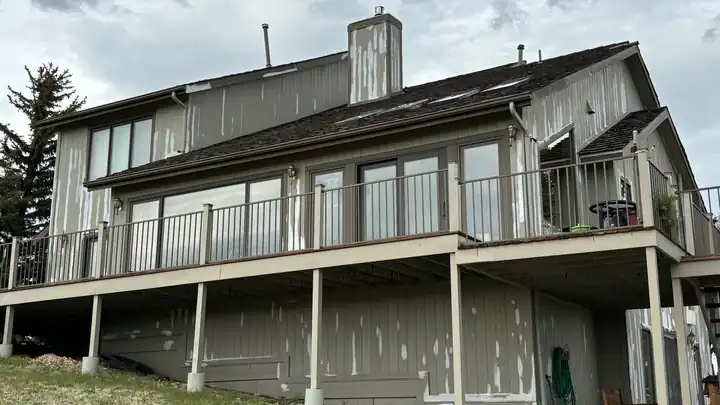
Start with safety, then look closely
Wind damage isn't always dramatic. Sometimes the storm door is hanging a little crooked and the patio cover is still standing, so you figure everything is fine. Before you touch anything, walk the area slowly. Look for loose boards or panels that could swing, sharp metal edges, nails or screws that pulled through, and any overhead piece that is no longer firmly attached. If a patio cover or pergola looks shifted or racked, keep people out from under it until someone has checked how it's anchored.
Take photos of everything before you move anything. They help whoever repairs the damage understand what happened, and they're useful if you decide to talk to your insurance company.
The storm door takes the first hit
A storm door is basically a big light sail on a hinge. When a strong gust catches it open, it swings past its normal stop, and all that force lands on the weakest points: the hinges, the screws holding them to the frame, the closer arm, and the corners of the door itself. Here's what to check.
- Close it slowly and watch the gap. A door that no longer sits flush, or that hits the frame in one corner, has probably been pulled out of square or has loose hinge screws.
- Look at the closer. A bent or detached arm, or a cylinder leaking oil, won't hold the door against the next gust.
- Check the hinge side of the frame for torn or stripped screw holes and for cracked wood around them.
- Inspect the glass or screen panel and the corner joints. A cracked corner or a sprung panel means the door has flexed more than it should.
- Try the handle and latch. If the door doesn't catch, or catches only when you slam it, the latch plate has probably shifted.
Quick repair or full rebuild
Many storm door problems are quick fixes. Stripped screw holes in wood can be repaired by filling them with glue and wood and driving the screws back into solid material, or by moving to longer screws that reach the framing behind the trim. A bent closer arm can be replaced. A shifted latch can be realigned. These are small jobs, and most can be finished in a single visit.
A rebuild comes into the picture when the damage is structural. That means the door itself is bent or twisted, the frame it hangs in has split along the hinge side, or the door is so far out of square that a repair won't hold. If the wood around the hinges turns out to be rotted, the rot needs to be dealt with too, because new hardware needs something solid to bite into. A good rule of thumb: if you fix the damage but leave the weak point that failed, the next strong gust will test the same spot again.
Patio damage is slower to show
Wind doesn't only push sideways. It also lifts. A patio cover or pergola behaves a bit like a wing, and a strong gust can pull on every fastener that holds it down. The result is often damage you can't see from the yard: a post that shifted on its base, a connection that loosened, a screw that backed out a quarter inch. Walk the patio, deck or covered area and go through the following.
- Posts and bases: grab each post and push. Any wobble that wasn't there before needs attention.
- Where the structure meets the house: look for gaps, pulled fasteners, or cracked trim along the connection.
- Railings and stairs: shake them. Loose railing is a safety problem, not just a cosmetic one.
- Boards and panels: look for lifted ends, popped screws, and anything that has bent or cracked.
- Concrete: look for new cracks, edges that have shifted, and spots where water now pools.
A real example from a Cheyenne customer
Here is how one customer described a wind repair in a Google review of LJC General Services. Judith Beach wrote: "Luis repaired our back patio & storm door that were wind damaged and impossible to use. He did a professional, clean & complete job very quickly at a reasonable price. I recommend him highly." The phrase "impossible to use" is worth noticing. A door that won't close and a patio you can't safely step onto affect daily life right away, which is why damage like this usually gets handled as one repair job rather than two separate problems.
A sensible order of repairs
Make the area safe first: secure or remove anything loose. Then let wet wood dry out before you judge it. Then repair the structure, meaning posts, connections, hinges and frames, before you worry about finish. Paint or stain goes on last, because there's no point finishing a surface you may have to take apart. If you have several wind-related items, ask for them to be looked at together, so the order of work makes sense and nobody fixes something twice.
LJC General Services lists handyman services and remodeling on its site, which covers most storm door and patio repairs. If wind has left something at your house hanging, loose or unusable, call (307) 757-7287, Monday through Saturday, 7am to 7pm, and describe what you're seeing.
LJC General Services, (307) 757-7287
Call (307) 757-7287More articles
When and How to Restain a Deck in Cheyenne's Sun and Wind
A Cheyenne deck fades and grays on its own schedule, and the boards will tell you when the finish has stopped doing its job.
Rockscape, Rock Walkway or Sod for a Dry Cheyenne Yard
Each ground cover has a job it does well and a job it does poorly, and a dry, windy yard exposes the difference quickly.